

The racist edict that allowed Columbus to colonize and slaughter Indigenous people is still the law in the U.S. today.
What holiday we celebrate on the second Monday in October matters because it reflects the beliefs we hold about who we are and where we come from as a country.

Like many people, I first learned about Columbus in elementary school. I can still bring to mind the pile of popsicle sticks my teacher instructed me to glue together in the shape of a ship. We learned, of course, that Columbus was a brave man who, when everyone else thought the world was flat, sailed straight across the great ocean blue. We learned that he “discovered” America. Even in my child’s mind I knew something was off. I remember knowing that if Columbus had never come here, my Cherokee family would still have our land.
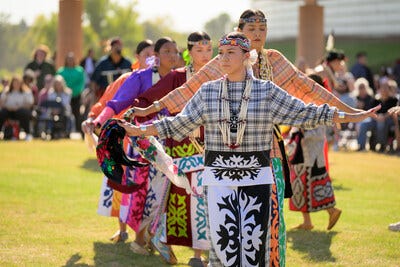
Like many parts of American history, the story of Columbus is contested. After years of advocacy and growing awareness of Columbus’s human rights abuses, some states and cities switched to celebrating Indigenous Peoples Day. Now, we are witnessing the backlash to that modicum of change. On social media earlier this year, President Trump vowed to bring back Columbus Day ”from the ashes.” While running for office, Vice Presidential JD Vance called Indigenous Peoples Day a “fake holiday.”
What holiday we celebrate on the second Monday in October matters because it reflects the beliefs we hold about who we are and where we come from as a country. More often than not those beliefs are reflected in law and policy. That is true for the story of Columbus. The 15th century legal doctrine he used to colonize and slaughter the Indigenous peoples is still the law in the U.S. today.
The “Doctrine of Discovery” first appeared in 1455 as a papal bull giving Portugal permission to invade and colonize West Africa. After Columbus’s infamous voyage, a similar papal bull was extended to Spain in 1493. In these decrees, the Pope divided the world between Christian and non-Christian nations. People who didn’t practice Christianity were deemed “uncivilized“ and not worthy of basic human rights. Fundamentally, the Doctrine of Discovery declared that any land, treasure, and even people belonging to non-Christian nations were free for the taking. Europeans used this international law, grounded in the racist presumption of European superiority, to colonize most of the earth. When Spain proposed to the UN General Assembly that the 500-year anniversary of Columbus’s voyage should be marked by celebration, the entire African delegation walked out.
The Doctrine of Discovery was codified into U.S. law by the Supreme court in 1823. That year, in Johnson v McIntosh, the Court ruled that Indigenous nations did not own their land, but were “occupants” or tenants–making the United States their landlord. After the Revolutionary War, the theory went, the U.S. inherited the land from the British, and the British had owned it by right of “discovery.” This Supreme Court decision has never been overturned or struck down. McIntosh is still taught in law schools as one of the building blocks of U.S. property law and the Doctrine of Discovery is still a foundational part of American law. Without it, the United States’s existence on Indigenous land would be illegal.
The Doctrine of Discovery was cited by a U.S. Appeals Court as recently as 2014 and by the Supreme Court as recently as 2005. That Supreme Court decision, City of Sherrill v. Oneida Nation of Indians, was authored by the late Justice Ruth Bader Ginsburg. After the Oneida Nation bought back land that had been illegally ceded to the state of New York, the city of Sherrill wanted the tribe to pay property taxes. In City of Sherrill v. Oneida Indian Nation of New York the Supreme Court ruled that the disputed land could not be placed back under the tribe’s jurisdiction because it had been taken so long ago and it would cause too much of a disruption to change it now. Writing for the majority, Justice Ruth Bader Ginsburg told a distorted history, claiming “it was not until lately that the Oneidas sought to regain ancient sovereignty over land converted from wilderness to become part of cities like Sherrill.” Now, it was too late, she opined, for the tribe to “rekindle the embers of sovereignty that long ago grew cold.”
In the first footnote of her decision, Ginsburg cited the Doctrine of Discovery stating “…the lands occupied by Indians when the colonists arrived became vested in the sovereign – first the discovering European nation and later the original States and the United States.”
Since McIntosh–and even since Sherrill–tribes have fought for and won important legal victories at the Supreme Court and Congress. But Native nations do not have a constitutional amendment or Supreme Court decision that ended our legal subordination. If the United States wants to take more of our land–like terminate a reservation or take land out of trust–it still has the power to do so.
Today, on October 13th, many people across the United States will celebrate Indigenous Peoples Day. What started as a grassroots movement has spread across the country. This year, 17 states, Washington, D.C., and 221 cities will officially recognize Indigenous Peoples Day or something similar. From New York City, to Oklahoma to LA, Indigenous people will gather to mark the day with musical performances, Indian football, and dancing.
Only 13 states still observe the second Monday in October as a paid public holiday exclusively called Columbus Day. The rejection of Columbus Day comes in part from his well-documented human rights abuses. By enslaving Indigenous Taino people and shipping them to Europe, Columbus was responsible for the first transportation of enslaved people across the Atlantic. He and his men sex-trafficked Indigenous women and girls, some as young as nine years old. To force Taino people to collect gold for Spain, Columbus’s army would chop off their hands if they did not comply. Like a tyrant, Columbus cut out the tongues of people who dared criticize him.
During the 2020 racial reckoning after the police murder of George Floyd many statues of Christopher Columbus came down, but the holiday survived. Now that the backlash to that reckoning is in full swing, the holiday is unlikely to go anywhere anytime soon. Columbus Day is still a federal holiday. Indigenous Peoples Day is not.
The culture war currently being fought over what history should be taught and what is not about the past. It has everything to do with our present. The fight over truth is so bitter because power flows from the dominant narrative: the power to shape both public sentiment and public policy. The same country that still celebrates Columbus Day also holds hundreds of tribes in legal subordination. And the United States’ right to Indigenous land still relies on a 15th-century edict unabashedly awash in white supremacy.
I want to hear from you!
I’m just starting this newsletter and I would love your feedback! As a freelance writer, I was frustrated with my writing living in multiple places and wanted a space to connect with my readers directly. I’d love to hear your thoughts! What topics are you curious about? Where would you like to see this newsletter go?
Support Native America!
If you like what you’re reading, please consider becoming a paid subscriber. For as little as $2 a month you can support my writing. Another great way to support this newsletter is to share it!
I am not unfamiliar with Indigenous history, but I somehow never realized the Doctrine of Discovery is used in the Courts. This is the type of content I’m here for. Thank you. Happy Indigenous Day!
I have also been dismayed at the backlash against Indigenous Day and I appreciate this essay. Not to take away from any of your points at all, but I will add that fwiw Pope Francis officially repudiated the Doctrine of Discovery in 2023. This is definitely in the category of "too little too late" but I mention it for the sake of completeness.
https://www.npr.org/2023/03/30/1167056438/vatican-doctrine-of-discovery-colonialism-indigenous